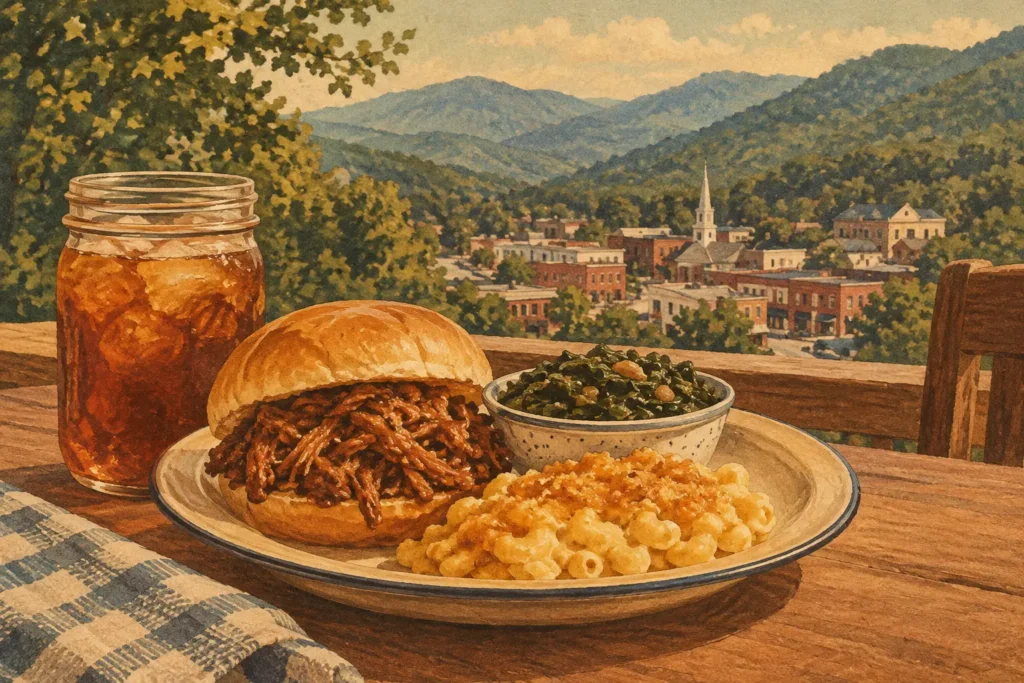
A good Appalachian tasting review should begin before the first bite. In West Jefferson, it might begin with the brick beneath your shoes, a painted wall across the street, or a downtown building that has watched generations come and go. The food is delicious, certainly. But around here, a biscuit, a slice of pie, or a thoughtfully made bite can also be a clue.
That is the pleasure of tasting your way through West Jefferson. You are not simply deciding whether something is sweet, smoky, crispy, or worth ordering again. You are meeting a town through the people who feed it, make art in it, tell stories about it, and keep its corners lively.
What an Appalachian Tasting Review Should Notice
Appalachian food is often described with big, broad words: hearty, home-style, comforting. Those words are not wrong, but they can flatten a place with a lot of character. A real tasting tells us more when we slow down and ask a few better questions.
Who made this? What grows, gathers, or gets remembered in this region? Why does this particular flavor belong in this particular storefront, on this particular block of West Jefferson?
Sometimes the answer is practical. Mountain cooking has always had a sensible streak – use what is available, waste little, feed people well. You may taste that spirit in familiar ingredients handled with care: apples, cornmeal, beans, country ham, greens, local dairy, seasonal berries, and recipes that know the value of a hot skillet.
But Appalachian food is not frozen in time, and that matters. West Jefferson’s food scene can hold a traditional flavor beside a newer idea without either one canceling the other out. A baker may work from an old comfort-food instinct while adding a fresh twist. A lunch counter can feel wonderfully familiar, while an independent kitchen nearby tries something you did not expect to find on a small-town main street. That mix is part of the point.
The most satisfying review is not a scorecard. It is a record of place.
The First Taste: Familiar, But Not Ordinary
The first thing visitors often notice is generosity. Not just portion size, though nobody is likely to complain about a plate that leaves room for a good afternoon walk. Generosity also shows up in the welcome, the easy conversation, and the feeling that a meal is meant to be shared rather than rushed through.
That is an Appalachian strength worth noticing. The best local food does not need to announce itself with fancy language. It arrives warm, smells right, and makes you curious about the person behind the counter. A server may point you toward a favorite. An owner may tell you what sells out first. Suddenly, lunch has a narrator.
There is a trade-off, of course. If you are looking for a tightly choreographed, white-tablecloth tasting menu, downtown West Jefferson may not be trying to be that town. Its charm lies elsewhere: in independent places with real personalities, in food that feels connected to the day, and in the occasional happy surprise that comes from following your nose rather than a rigid itinerary.
For some travelers, that is exactly the luxury.
Look for the story behind the comfort food
A biscuit is never just a biscuit when someone can tell you whose recipe inspired it, how the kitchen came to be, or why that flavor still draws regulars through the door. The same goes for a scoop of ice cream, a savory snack, or a pastry tucked into a paper bag for later.
Food gives visitors an easy way into these conversations. You do not need a culinary vocabulary. You only need enough curiosity to ask, “What do people around here love?” That question can lead to a favorite dish, a local character, or a story about how West Jefferson changed while still holding onto the parts that matter.
An Appalachian Tasting Review of Downtown, Too
West Jefferson deserves to be tasted with your eyes open. Between stops, look up. Downtown’s murals give the streets a bright, open-air gallery feeling, adding color and a little mischief to an ordinary stroll. They are not background decoration. They are part of the town’s ongoing conversation about art, identity, and who gets to leave a mark on a wall.
Then there are the buildings. The Old Hotel, for instance, invites a pause. Even before you know every detail of its past, you can feel the question hanging there: who came through these doors when the town was younger, and what did they see when they stepped back onto the street? Old buildings are good at making us realize that a downtown is not a set. It is a collection of lives, businesses, weathered plans, and second chances.
A tasting review that skips this setting misses half the flavor. The same bite can feel different after hearing a story about a nearby building or seeing an artist’s work around the corner. That is not marketing magic. It is context. Place changes the way we pay attention.
Music belongs in the picture, too. In the High Country, music has a way of turning up where people gather – sometimes planned, sometimes simply part of the hum of the day. Its roots run deep in the region, but it is not a museum piece. Like the food, it keeps moving through new hands and new rooms.
What Makes a Tasting Feel Truly Local?
Local does not have to mean every ingredient traveled ten miles or every recipe is a family secret. Those standards can be a little too neat for real life. A restaurant may source wisely from near and far. A maker may bring in ideas from another place. A town shaped by visitors and newcomers will naturally have more than one influence on its plate.
What makes a tasting feel local is connection. The people serving it know their neighbors. The business has a relationship to the block it occupies. The food gives you a reason to learn what happened before you arrived and what is happening now.
That is why an afternoon in West Jefferson can be more memorable than simply hunting down a highly rated meal. You may arrive with a list of places to try, then leave talking about the mural you almost walked past, the person who told a story with perfect timing, or the old storefront you now want to know more about.
Food is the doorway. West Jefferson is the story.
A few ways to taste with more curiosity
Start with one thing you would not normally order. It does not need to be daring. Choose the regional special, the seasonal dessert, or the item the person behind the counter recommends without hesitation.
Give yourself time between bites. West Jefferson is walkable, and the space between food stops is where details begin to show themselves. Notice a hand-painted sign, a window display, a porch, an old cornice, or the sound drifting from a nearby doorway.
Finally, let one question lead to another. If you hear about an artist, look for their work. If someone mentions an old building, take a closer look. If a local suggests a favorite spot, consider why they chose it. The town gets more interesting when you follow its threads.
Why a Guided Tasting Can Change the Meal
There is nothing wrong with wandering downtown and choosing lunch on instinct. In fact, that can be a fine way to spend a day. But visitors do not always know which door holds the good story, which mural has a local connection, or why a seemingly ordinary building deserves a second glance.
A small-group experience such as High Country Food Tours can help make those connections without turning the afternoon into a lecture. Ten hungry people is a good size for conversation. You can taste several things, hear the tales that give each stop a little more meaning, and still have room to explore on your own afterward.
The benefit is not that someone tells you exactly what to think. It is that you start seeing more. A meal becomes an introduction, and the town feels less like a stop on the way somewhere else.
So, how does West Jefferson fare in an Appalachian tasting review? Best measured not by stars, but by the lingering questions it leaves behind. Which maker’s story will you remember? What was happening inside the Old Hotel years ago? What will be around the next corner?
Leave a little room after dessert. West Jefferson has a way of offering one more story when you think you are finished.