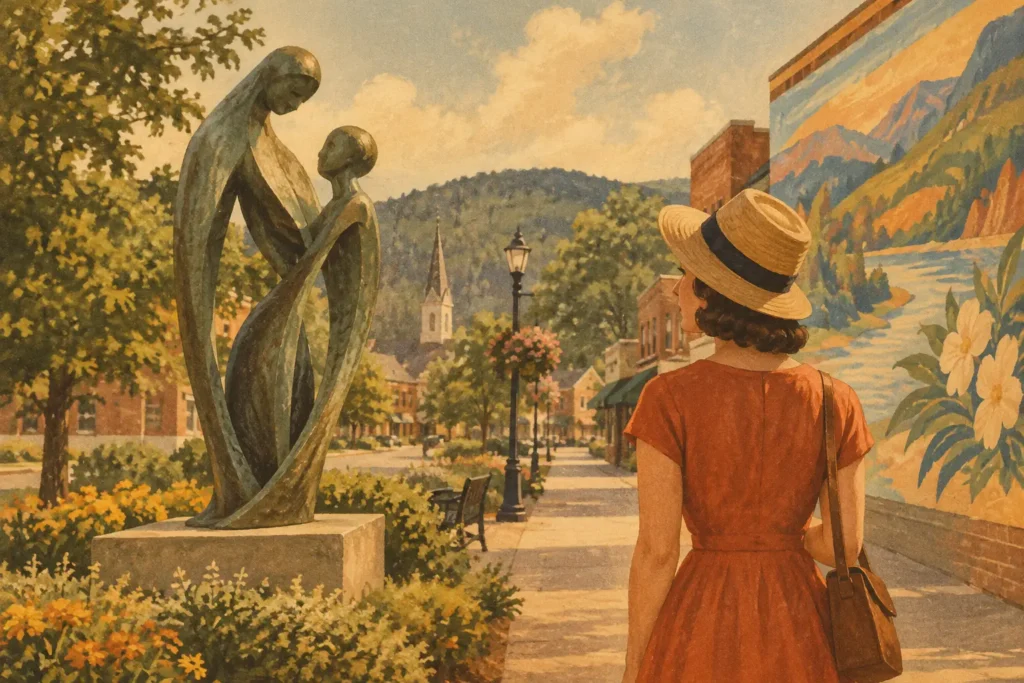
A mural can make you stop mid-sentence. That is part of the pleasure of West Jefferson public art: you may arrive thinking about lunch, then find yourself looking up at a brick wall, wondering who painted it, what used to be in that building, and where the afternoon went.
Downtown West Jefferson has the kind of walkable scale that rewards wandering. Its art is not tucked away behind a museum door or reserved for people who know the right vocabulary. It lives out in the open, alongside storefronts, windows, sidewalks, old masonry, and the small businesses that give Main Street its daily rhythm. You can take it in between bites, conversations, and the happy little detours that turn a visit into a real memory.
West Jefferson Public Art Is Part of the Downtown Conversation
Public art changes how a town introduces itself. In West Jefferson, murals add color, certainly, but their bigger job is storytelling. They point toward the people, landscapes, traditions, and imaginations that have shaped this corner of the High Country. A blank wall becomes a local landmark. A familiar street becomes a place where visitors pause long enough to notice details.
That pause matters. Small towns are often experienced too quickly: park, shop, eat, drive on. Art slows the pace just enough to make room for curiosity. You begin to see the texture of old brick, the painted trim above a storefront, the difference between a building that has been carefully kept and one that has been cleverly reimagined.
The downtown mural collection also gives a casual walk a bit of structure. Instead of asking, “What should we do after lunch?” you have a reason to wander another block. Families can let younger travelers pick a favorite image. Couples can take their time. Friend groups can compare notes and photographs. There is no quiz at the end, thankfully, but there is usually a stronger sense of place.
The Best Way to See It Is Slowly
West Jefferson is not a town that asks you to rush. Public art is easiest to appreciate when you leave room for the ordinary pleasures around it: coffee cooling in your hand, a window display that catches your eye, a neighbor greeting someone across the street.
Start with a loose plan rather than a packed schedule. Give yourself time to walk the main downtown blocks, then peek down side streets where a new angle or painted wall may be waiting. Art outdoors changes with the day. Morning light can bring out one set of colors; late-afternoon shadows can make a building feel entirely different.
A few habits make the stroll more rewarding:
- Look up. Some of the most interesting details are above eye level, where signs, cornices, and upper-story windows tell their own quiet stories.
- Step back before taking a photo. Murals often make more sense when you see their relationship to the whole building and street.
- Read nearby plaques, signs, or artist information when available. A name or date can turn a pretty image into a connection with a real person.
- Pause at an independent shop or café along the way. Downtown art is part of a living community, not a backdrop separated from it.
There is a trade-off, of course. If you are trying to see every shop, every gallery, every mural, and every mountain view in one afternoon, you will miss the small surprises. Choose a few things to notice well. West Jefferson will still be here when you return.
Murals Make Room for Local Character
Murals are especially good at showing a town’s personality without requiring a formal introduction. They can be playful, nostalgic, bright, reflective, or a little eccentric. That feels right for West Jefferson, where creative energy sits comfortably beside old-fashioned friendliness and Appalachian practicality.
Public art also gives visitors a useful way into local culture. You do not need to arrive with an art-history degree. You simply need to ask a few questions: What do I recognize? What feels surprising? Does this image connect to the land, a local tradition, or the people who live here?
Those questions tend to lead somewhere. Maybe they lead to a conversation with a shop owner. Maybe they lead to an artist’s work in a gallery window. Maybe they lead to a story about why downtown West Jefferson has such a strong creative presence in the first place. The town’s art scene is not one thing or one wall. It is a web of working artists, makers, musicians, business owners, volunteers, and residents who keep putting care into the place they call home.
A Photo Stop Can Become a Story Stop
It is easy to treat murals as a checklist: find wall, take photo, post photo, move on. There is nothing wrong with a good photo. But the more interesting version of the stop is asking what surrounds it.
What is the building’s history? Who works nearby? What was here before the current business moved in? In a downtown built from layers of use and reuse, the wall is only part of the picture. The people and buildings around it provide the rest.
Do Not Walk Past the Old Hotel Too Quickly
The Old Hotel is one of those places that helps you read West Jefferson differently. Historic buildings have a way of holding onto questions. Who came through the door when the building served its original purpose? What news was exchanged there? What did travelers see when they arrived in town a century ago, and what would they recognize today?
You do not need every answer for the building to work its magic. Standing near the Old Hotel, it becomes easier to picture downtown as more than a collection of pleasant storefronts. It is a place that has welcomed visitors, weathered change, and found new uses for old spaces.
That is one reason public art feels so at home here. It creates a conversation between past and present. A historic facade provides the frame; contemporary color and ideas give the street fresh energy. Neither cancels the other out. Together, they keep the downtown from becoming a frozen postcard.
For visitors, this is a useful reminder: take time to notice the building behind the mural, not just the mural itself. Look at the windows, brickwork, stairs, and signs. West Jefferson’s visual story is written in layers.
Let Food Be the Doorway, Not the Finish Line
A good meal can be the beginning of an art walk rather than the thing that ends it. That is one of the best rhythms for a downtown afternoon: settle in somewhere local, share a bite or something sweet, then head back outside with nowhere urgent to be.
Food naturally opens conversations. Ask where an ingredient came from, how long a business has been around, or what the owner recommends seeing nearby. In a town this size, the answer may come with a story, a strong opinion, or directions that begin with “You can’t miss it, unless you turn too soon.” Those are the directions worth getting.
High Country Food Tours approaches West Jefferson in much the same spirit. The food is delicious, but it is also a doorway into the people, history, art, and unexpected details that make downtown more than a place to grab lunch. One tasting can lead to a story about a building. One mural can lead to a conversation about a local maker. Before long, the town begins to feel less like a stop on the map and more like a place with a pulse.
Make Your Own Art-and-Appetite Afternoon
The ideal West Jefferson art walk depends on your group. A family with children may want a shorter loop with room for snacks and plenty of photo stops. A couple celebrating a weekend away may prefer a lingering lunch followed by galleries, murals, and an unhurried look at historic architecture. A group of friends might build the whole afternoon around sharing food, comparing favorite walls, and wandering until someone spots another shop worth visiting.
Whatever your pace, leave some blank space in the plan. Public art is an invitation, not an assignment. You may discover a mural that sends you down an unexpected block, a musician setting up nearby, or a storefront that makes you change course entirely.
Bring your appetite, comfortable shoes, and a little curiosity. Around the next corner, West Jefferson may have a story waiting on a wall.