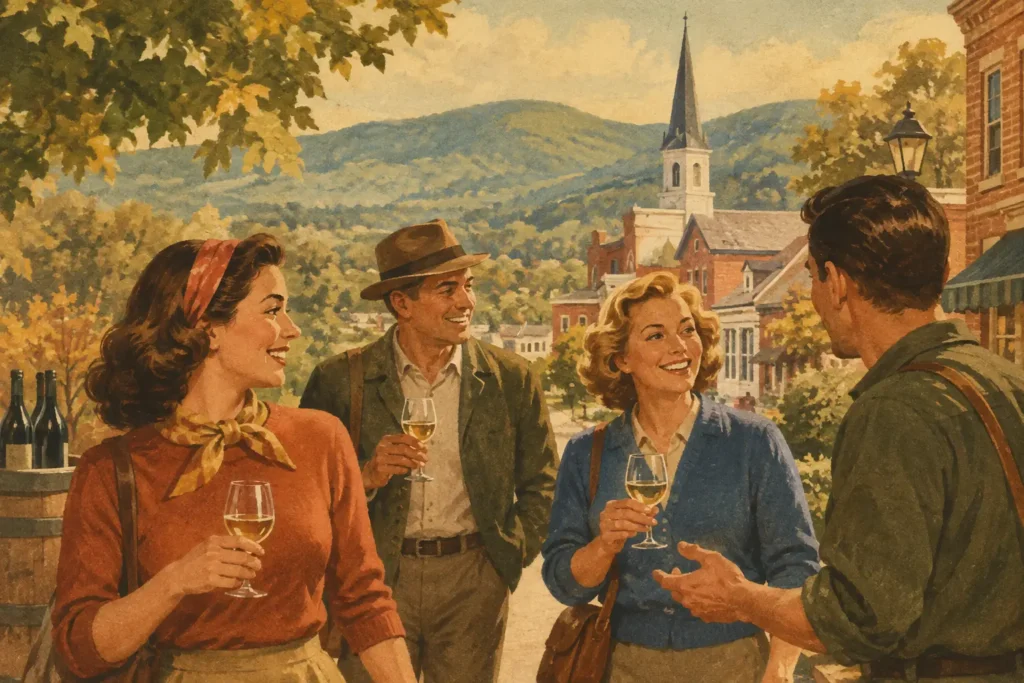
A good afternoon in West Jefferson can begin with something as simple as a bite of something warm, sweet, savory, or unexpected. Then someone points up at a mural you might have walked past. A story surfaces about the old hotel downtown. Suddenly, lunch has turned into a town you can read a little differently.
That is the thread running through much of the guided tasting walk feedback we hear from visitors: people arrive looking for a pleasant way to eat their way around downtown, but they leave talking about the people, buildings, art, and little details between the tasting stops. Food gets everyone through the door. West Jefferson tends to do the rest.
What Guests Notice on a Guided Tasting Walk
The first thing guests often mention is that West Jefferson feels more layered when someone helps connect the dots. Downtown is walkable, friendly, and full of independent places with their own personalities. But a visitor can easily pass a painted wall, a historic storefront, or an old building without knowing what they are seeing.
A guided walk slows the pace just enough to make room for those details. There is time to taste a local specialty, hear why a business owner chose this town, and look across the street at a building that has seen more than one version of West Jefferson. The stops matter, of course. So does what happens on the sidewalk between them.
Guests also appreciate that the experience does not require a food critic’s vocabulary or a full afternoon of planning. Come hungry, wear comfortable shoes, and bring your curiosity. The tastings are generous enough to feel like part of a meal, while the route offers an easy introduction to downtown for first-time visitors and a fresh angle for people who have visited before.
It Feels Like an Introduction, Not a Lecture
The most useful guided tasting walk feedback is not usually about memorizing dates or identifying ingredients. It is about feeling welcomed into a place. A good guide can share history without turning a stroll into a classroom and point out public art without making anyone feel as if there will be a quiz later.
That balance matters in a town like West Jefferson. Its stories are not tucked away in one museum or confined to a single block. They show up in the businesses that have held on, the new ideas moving into old spaces, the artists whose work brings color to brick walls, and the locals who still know a story worth telling.
Sometimes the best comment is a simple one: “I never would have found that on my own.” It may refer to a tucked-away tasting, a favorite shop, or the history behind a familiar-looking facade. Either way, it means the town has become more than a pin on a map.
Why the Old Hotel Gets People Talking
Did you know that one of downtown’s most intriguing landmarks is the Old Hotel? It has the kind of presence that invites questions. You can look at it and sense that it has witnessed a parade of travelers, town conversations, changing storefronts, and ordinary days that eventually became history.
The Old Hotel is a reminder that West Jefferson did not appear fully formed as a charming day-trip destination. It grew through work, commerce, weather, community arguments, celebrations, and the steady rhythm of people making a life in the High Country. When visitors hear a story connected to an old building, the street around it becomes more vivid.
That is why history belongs on a tasting walk. A meal gives people a reason to gather. A story gives the gathering a place. The pairing may be a little quirky, but it works: one minute you are considering a delicious bite, and the next you are wondering who walked through a doorway a century ago.
Food Opens the Conversation
There is no single flavor that explains West Jefferson, and that is part of the fun. Downtown food reflects the people who run the kitchens, counters, and shops. Some bring family traditions. Some bring a creative twist. Some simply make the sort of thing that makes you pause, take another bite, and ask, “How did they do that?”
What guests tend to respond to is the story behind the food. A tasting has more meaning when you know something about the hands that made it, the business that serves it, or the local habit that inspired it. It is less about checking dishes off a list and more about meeting the town through its table.
That also means every tour day can feel a bit different. A business owner may be at the counter. The weather may change the mood of the street. A new piece of art might catch your eye. The route has a shape, but West Jefferson is a living town, not a stage set.
The Best Kind of Surprise Is Specific
Generic compliments are nice, but the feedback that stays with us is wonderfully specific. Someone remembers the musician mentioned during a story. Someone else notices a mural artist’s signature after the tour. A family returns to a shop they first discovered while walking with the group. A couple decides to come back downtown for dinner because they spotted a place they want to try next time.
Those details say more than “we had fun.” They show that people were paying attention and that the experience gave them a few new threads to follow. West Jefferson has a way of rewarding that kind of attention.
The murals are a fine example. They are not background decoration. They add color, humor, memory, and local character to the downtown streetscape. When a guide shares who created a work or what it represents, visitors often look longer. Later, they may find themselves pointing it out to someone else. That is how a town’s art becomes part of a visitor’s own story.
What Honest Feedback Helps Us Improve
Warm feedback is encouraging, but honest feedback is useful too. Walking tours involve real-world variables: changing weather, dietary needs, different mobility levels, busy sidewalks, and the fact that every group brings its own pace and personality.
The goal is not to make every moment overly polished. The goal is to make guests comfortable, well fed, and included. If a visitor says a stop felt rushed, that is worth hearing. If someone needs clearer information about a food preference or the walking route, that helps create a better experience for the next group. If a guest particularly enjoyed a local story, that is a clue that the story deserves to be told with care again.
Feedback also reminds us that visitors come for different reasons. Some are celebrating a birthday. Some are hosting out-of-town family. Some are looking for an easy afternoon with friends. Others are drawn to the history, the murals, or the chance to understand a High Country town beyond the usual overlooks and scenic drives. A good guided walk makes room for all of them.
A Few Ways to Make Your Walk More Memorable
You do not need to arrive with a research plan. Still, curiosity goes a long way. Ask the question that pops into your head. Notice the old signs, the upstairs windows, and the names on the storefronts. Take a moment with the murals instead of just taking a photo of them.
If a tasting introduces you to a place you like, consider returning another day. If a story makes you curious about the Old Hotel or another downtown building, look at it again before you leave. The tour is a beginning, not a box to check.
That may be the most encouraging part of guided tasting walk feedback. Visitors often say they came for food, then found themselves lingering over a story, revisiting a favorite shop, or seeing a familiar street with fresh eyes. Leave a little room in your afternoon for that sort of surprise. West Jefferson is good at meeting you around the next corner.