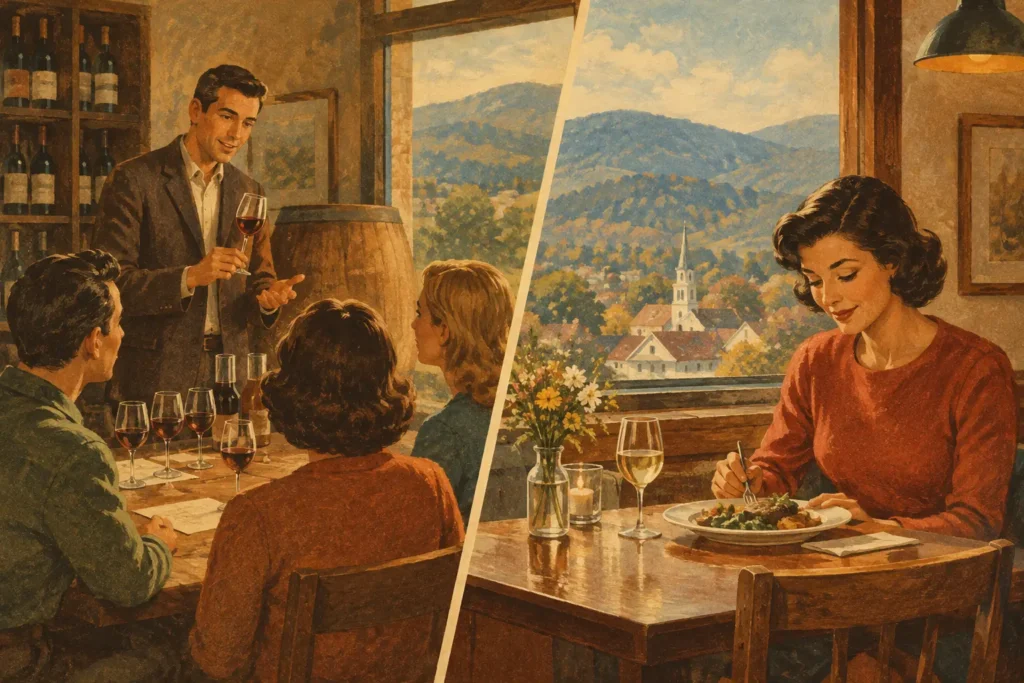
A table for two can be a fine way to spend an afternoon in West Jefferson. You pick a place that smells good, settle in, order what catches your eye, and let lunch unfold at its own pace. But guided tasting versus solo dining is not really a question of which option serves better food. It is a question of what you hope to bring home besides a happy appetite.
In a town where a mural may point toward a local artist’s story and an old building can make you wonder who stood there a century ago, a meal can be more than a meal. It can be the first clue.
The pleasure of finding your own table
Solo dining, whether you are truly on your own or traveling with your favorite people, has a particular charm. You can wander until a sandwich board, a pastry case, or a sunny patio makes the decision for you. There is no schedule to keep. If coffee turns into conversation with a shop owner, or if you want to browse a gallery longer than planned, that is entirely your business.
This approach works especially well for visitors who already know West Jefferson a little. Maybe you return every year for the High Country air, have a beloved downtown stop, or simply enjoy the small adventure of making your own discoveries. You can follow your appetite, linger over one dish, and build the day around whatever catches your attention.
There is also something satisfying about the lucky find. Perhaps you turn a corner and spot a painted wall you had not seen before. Perhaps the person behind the counter tells you why a recipe matters to their family. Those moments feel personal because they are personal. You found them yourself.
Still, solo dining asks you to do some of the work. You need to choose where to go, decide what fits your group, and know enough to look beyond the first appealing storefront. A downtown can seem easy to read until you realize the most interesting story is tucked behind an unassuming door or written into the brick above your head.
Guided tasting versus solo dining: the real difference
A guided tasting changes the rhythm of the afternoon. Instead of asking, “Where should we eat?” you begin with, “What are we about to notice?” Food arrives in smaller, generous tasting moments, but the experience has a wider frame. A guide helps connect the bite in your hand to the people who made it, the block where you are standing, and the town that grew around both.
That does not mean every visitor needs a guide. If your ideal afternoon is quiet, unplanned, and built around one long lunch, solo dining may be exactly right. If you are curious about why downtown West Jefferson looks the way it does, who has shaped it, and where its creative energy comes from, a guided tasting offers context that is hard to get from a menu alone.
The difference is not fancy food knowledge. No one needs to know the proper way to discuss a biscuit or possess strong opinions about cheese. The value is having a friendly local host who can say, in effect, “Look up for a second. There is a good story here.”
A tasting tour is also a gentle answer to group decision fatigue, that little drama familiar to couples, families, and friend groups everywhere. One person wants something savory, another is eyeing sweets, and someone else is already wondering about a drink. Sampling several stops lets the group share the fun without turning lunch into a committee meeting.
Food opens the door, but the town walks in
West Jefferson is compact enough to explore on foot and layered enough that a short walk can hold several eras at once. There are independent businesses with their own personalities, public art that gives walls a voice, and streets where old architecture still has plenty to say if someone knows how to introduce it.
Take the Old Hotel. It is the kind of building that can become part of the background if you hurry past it on the way to lunch. Slow down, though, and it becomes a reminder that downtown has welcomed travelers for a long time. The questions start to gather: Who arrived here when the roads were different? What did the town need then? What changed, and what did not?
You do not need a history lecture to enjoy that feeling. A good story can be brief, a little surprising, and just enough to make the next block look different. Suddenly, the shop window is not simply a shop window. It is part of a living downtown where owners, artists, cooks, musicians, and neighbors continue to add their chapters.
That is where guided tastings have an edge. They make connections visible. A local flavor is not presented as a novelty with a bow on it. It is part of a wider conversation about the people who choose to make, create, and keep a business here. The food becomes a doorway, and West Jefferson is the story on the other side.
What a guide can reveal that a map cannot
Maps are useful. They can tell you where to park, where a street turns, and how close you are to the next cup of coffee. What they cannot always tell you is why a mural belongs on that wall, which local personality is known for a particular welcome, or how a historic building fits into the town’s longer story.
A knowledgeable guide can also help visitors notice details they might otherwise miss: the color and motion in a piece of public art, the character of a storefront, or the way food traditions travel through families and communities. These are not secret passwords to an exclusive club. They are invitations to pay attention.
For first-time visitors, that introduction can be especially helpful. Rather than spending the first afternoon trying to get oriented, you begin with a sense of the place and a handful of names, flavors, and landmarks to revisit later. A tour can make the rest of your stay easier without making it feel overplanned.
For returning visitors, the benefit is different. You may discover that the town you thought you knew has another layer. Downtown places evolve. A new maker moves in. An artist’s work gives an alley or exterior wall fresh life. A familiar stop has a story you never heard because you were busy deciding between lunch specials.
When solo dining is the better choice
There is no prize for choosing the most structured itinerary. Solo dining is often the better fit when time is loose, your group has a favorite restaurant in mind, or you want a slow afternoon with room for detours. It can also be easier for visitors who prefer one full meal over a series of tastings.
If you have dietary needs, either option can work, but it helps to consider your comfort level. At a restaurant, you control the menu choice from the start. On a guided experience, asking ahead about accommodations gives the host a chance to explain what is possible. Clear expectations make for a more relaxed day.
Weather matters, too. West Jefferson rewards walking, but a drizzly day may make a long, self-guided stroll less appealing, while a guided route gives the walk a purpose and keeps the group moving. On a bright afternoon, you may prefer the freedom to sit outside, wander through shops, and let the town set the pace.
The best choice depends on whether you want to make the discoveries yourself or have someone begin the conversation. Both can lead to a good meal. Only one is designed to braid several meals, local stories, art, and historic corners into one shared afternoon.
Make room for one more corner
A guided food experience should not replace your own wandering. It should make that wandering more interesting. After hearing a story about a building, you may want to circle back and look at it again. After meeting a local business owner or tasting something memorable, you may return another day with more time and a bigger appetite.
That is the lovely trade-off. A guide gives you a starting point, not a script for every hour that follows. High Country Food Tours is built around that idea: delicious food, yes, but also the pleasure of seeing downtown West Jefferson as a place full of people and small surprises.
So choose the afternoon that suits you. Follow a menu when you want freedom. Join a tasting when you want the stories behind the signs, flavors, and faces. Then leave a little time afterward for the corner you have not turned yet.