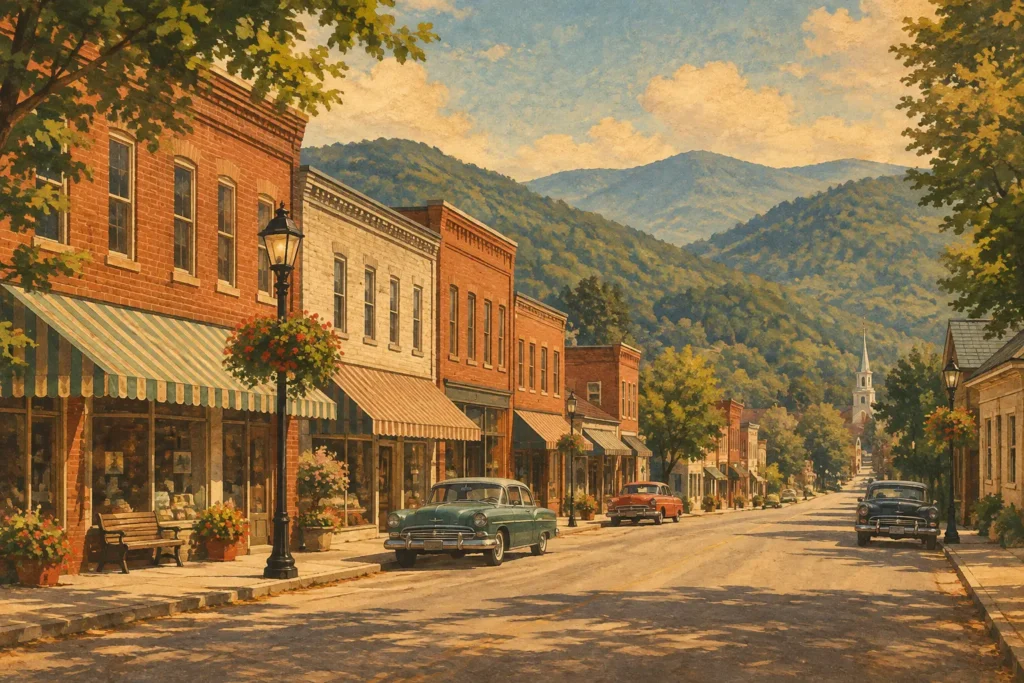
The Old Hotel is a good place to begin because it asks a very West Jefferson question: what happened here before we arrived? Its weathered presence on downtown’s edge is not just a photogenic old building. It is a reminder that this little town has welcomed travelers, work, commerce, conversations, and more than a few characters for a long time.
That is the secret of a good guide to Appalachian main streets. You do not rush through town looking only for a place to park, a souvenir, or lunch. You slow down enough to notice the layers. In West Jefferson, food may get you through the door, but a mural, a storefront window, an old brick wall, or a story from a shop owner may persuade you to stay awhile.
What Makes an Appalachian Main Street Worth Walking?
A main street is not made interesting by being perfectly preserved or polished into sameness. The best ones still feel lived in. They have a little practical business mixed with a little surprise: a place to pick up something useful, a gallery that catches your eye, a restaurant kitchen working hard behind a modest storefront, and perhaps a musician setting up for the evening.
West Jefferson’s downtown has that useful, curious mix. The streets are walkable, the pace is friendly, and the mountains never feel far away. Yet the appeal is not simply the view. It is the sense that independent businesses are still part of the town’s daily rhythm. People know the names behind the counter. Buildings have changed uses over the years. A visitor can come for a meal and leave wondering who painted that wall, what used to be in that storefront, or how a particular local tradition found its way here.
That kind of curiosity matters. Appalachian towns are often described as if they are frozen in time, but West Jefferson is better understood as a place where history and present-day creativity keep sharing the same block. The old and new do not always match neatly. That is part of the charm.
Start With a Slow Loop Around Downtown West Jefferson
There is no prize for seeing everything quickly. Give yourself enough time to wander the central blocks without a rigid checklist. Notice the storefronts before you decide where to eat. Look up at the upper floors, where details from an earlier era can be easy to miss. Then look at street level, where the town’s current story is being written by artists, cooks, makers, and business owners.
The Old Hotel is worth a pause for exactly that reason. Even without treating it like a museum label, you can feel the idea of the place: travelers coming through, rooms overhead, meals downstairs, news exchanged in passing. Historic buildings make better sense when we imagine the ordinary life that happened inside them. Somebody was late. Somebody was waiting. Somebody was hungry.
That last part is especially useful in West Jefferson. Food is one of the easiest ways into a town’s story because it brings together the people who make it, the folks who gather around it, and the local ingredients or traditions that influence it. A bakery case, a plate set down at a table, or a coffee shared before browsing galleries can tell you more about a place than a brochure ever could.
Let Food Be Your First Conversation
Instead of choosing a restaurant as a quick pit stop, treat it as a starting point. Ask what is made in-house. Notice what local flavors show up on the menu. If the person serving you has time, ask what they love about downtown or where they take visiting friends. These are not interrogation questions, thankfully. They are simply openings.
You may hear about an artist whose work is nearby, an event coming to town, or a building with a past you would have walked right past. Small towns are generous with this kind of knowledge when you make room for it.
A guided walk can help, too, especially for first-time visitors who want the food and the context together. High Country Food Tours uses tastings as a doorway into the people, murals, history, and local personalities that give downtown West Jefferson its character. The point is not to memorize facts. It is to see the next corner with a little more understanding.
Look for the Art That Changes the Block
West Jefferson’s murals are not background decoration. They are part of the town’s public conversation, adding color, memory, humor, and a sense of welcome to walls that might otherwise be overlooked. Take the time to stand back and take them in rather than treating them as a quick photo stop.
Look for artist credits when they are posted. Pay attention to what the images choose to celebrate: mountain life, local work, wildlife, music, heritage, or a bit of Appalachian wit. Public art often tells you what a community wants to keep visible. It can also reveal that a town is not interested in being reduced to one simple story.
The trade-off is that murals, galleries, and shops can be easy to experience too quickly, especially on a busy weekend. If you have only an hour, focus on one or two blocks and enjoy them properly. If you have an afternoon, leave breathing room between stops. West Jefferson rewards an unhurried visitor more than an over-scheduled one.
Listen for the Town’s Soundtrack
Every Appalachian main street has a soundtrack, though it is rarely the same from one visit to the next. In West Jefferson, it might be conversation spilling from a table, a bell above a shop door, an instrument being tuned for an evening gathering, or the gentle clatter of a working downtown.
Music belongs in the story because it brings people together in a different way than architecture or art can. You do not have to be an expert in bluegrass, old-time, country, or any other style to appreciate that connection. Just notice where people gather when music is happening. The room changes. Strangers become an audience, and an ordinary evening becomes a shared local memory.
If your visit happens to overlap with a downtown event, enjoy it, but do not assume the event is the whole experience. West Jefferson is still worth walking on a quieter weekday, when you can hear your own footsteps, linger over lunch, and have a real conversation with the people keeping the town moving.
A Guide to Appalachian Main Streets Means Meeting the People
The most memorable part of a small downtown is often not the most famous building. It is the person who tells you why that building matters. It is the cook who explains a favorite dish, the shopkeeper who remembers the previous tenant, or the artist whose work makes you stop halfway down the sidewalk.
That is why independent businesses matter so much here. They give a main street its particular voice. A town full of familiar storefronts can be convenient, but it may not tell you much about where you are. In West Jefferson, the local details are the point. They offer a chance to buy something with a story attached, eat something made by people you can meet, or carry home a memory that is more specific than a logo on a T-shirt.
Be a good visitor in return. Step inside. Ask before photographing people or private spaces. Be patient when a small business is busy. Spend your money thoughtfully if you can. Most of all, resist the urge to judge a town by whether it performs perfectly for you. Real places have quiet moments, closed doors, changing seasons, and rough edges.
Leave Room for One More Corner
A satisfying West Jefferson afternoon does not need to end with a grand finale. It might end with a second look at a mural, a dessert shared at the table, a conversation that runs longer than expected, or one final glance at the Old Hotel as you head back to the car.
That is the small magic of downtown: the feeling that you have not finished it, only started to know it. Let food open the first door. Then keep walking, looking up, and wondering what story is waiting around the next corner.